Resisting the Far Right Takeover of the UMN Board of Regents

We’ve got to take a good look at the Board of Regents (BOR) to make sense of the decomposition of higher education.

The last twenty-year history of the University of Minnesota (UMN) certainly illustrates this process: the divestment of state support; skyrocketing tuition; the rapid deterioration of working conditions for faculty, graduate workers, and staff; the increasing inaccessibility of public universities to marginalized communities, the corporate takeover; and coordinated right-wing assaults on academic freedom, student activism, and the humanities, liberal arts, and critical inquiry that challenge the status quo. 

As always, dissent within the UMN have all called into question our misguided faith in shared governance with the BOR. Consider, especially, (1) unionized clerical and custodial workers’ steadfast struggle for livable jobs and the dignity of their labor; (2) student protests that rebuke the hollow promises of diversity, equity, access, and inclusion because that is all a pack of lies and instead center the demands for Indigenous sovereignty, antiracism, and anticapitalism persistently; (3) graduate student workers’ struggles and faculty union organizing that have always pushed back aggressive union busting; and (4) a clarion call for divestment from fossil fuels and defunding of campus police that student-led movements are promoting. 

These currents of resistance are our miners’ canaries, as we confront head on the triumphantly brazen character of the BOR best embodied in the regent Michael Hsu. So long as Hsu sits on the BOR, we can expect the type of revanchism that anchors right-wing populism to root even deeper than it has already. 
This year, regent Hsu is vying to be re-elected for another six-year term from the 6th Congressional District. During his tenure, he has doggedly engaged in the consolidation of BOR’s governing power to fortify, from the top, a market-based model of higher education to make the UMN to become an elite institution for the privileged class and in turn empower investors, donors, technocrats, and all the right-wing allies in the public and private sectors. Hsu wants to run the public university as if it is a corporation, in tandem with the UMN Foundation as its hedge fund, unwavering support for the bloated Athletics Program*, and the backing of the Far Right political base. While he so often projects a populist image of himself as a champion of students by contesting tuition hikes, it is but a subterfuge to hide a more sinister motive.

Hsu, like regent Darrin Rosha exhibits enormous contempt toward all those who speak truth to power against the tuition increases and corporate takeover. Since 2018, the BOR and the central administration have repeatedly criminalized student protests. This may well be the local manifestation of a national right-wing attack on constitutional rights of protest and assembly that have been orchestrated by conservative think tanks like the Goldwater Institute, as the American Association for University Professors (AAUP) has documented here.  To say that such regents as Hsu and Rosah do not care about the public good misses the point entirely. For regents like Hsu and Rosha are decidedly on the side of politics that is determined to eliminate the right to higher education as a cornerstone of the broader struggle for racial justice, democracy, climate justice, and decolonization. 

This political problem, the right-wing proclivities of regents, appeared sharply during the April 2019 BOR meeting. Hsu and Rosha, along with Randy Simonson, a regent elected for his politics on abortion amid the politicization of a critical university reproductive health program (who is also vying to be re-elected for his second term, this time for six years, from the 1st Congressional District) led the way to delegitimize the work of the Task Force on Building Names and Institutional History, chaired by CLA Dean John Coleman and Law School and History faculty Susanna Blumenthal. These men rebuked the Task Force’s recommendations to change building names that bear the deep history of racism and anti-Semitism, namely Coffman Memorial Union, Nicholson Hall, Middlebrook Hall, and Coffey Hall. They had the audacity to challenge the academic integrity of trained historians and by extension, the humanities, critical ethnic studies, and liberal arts.

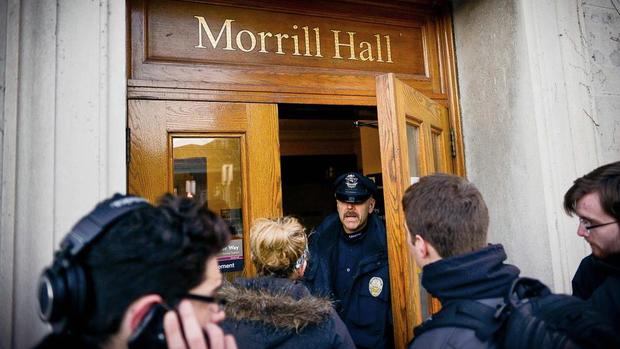
Sitting in the audience with many others who pushed back these regents’ gross act of academic dishonesty was Dr. John S. Wright, the esteemed scholar of African American & African Studies and English. He was one of the Black student activists, back in the late 1960s, that laid the groundwork for the Morrill Hall Takeover that radically transformed the University of Minnesota. With righteous indignation, Dr. Wright stood up and delivered a soliloquy, while he was threatened with arrest

How did such problematic regents secure six-year long seats on the Board in the first place? 

The answer is simple: the right wing and the state’s Republican party have learned to game the regent selection process in their favor, while their political opposition sits idly by, none the wiser to the dramatic shift in ideological orientation occurring on the Board.

The regent election process begins with the Regent Candidate Advisory Council (RCAC), a 24-member body of concerned citizens that is tasked with establishing the desired qualifications in a regent. They solicit applications for vacant seats on the Board every odd-numbered year, and recommend the names of several applicants for consideration by a Joint Committee of the Legislature. Eventually, a Joint Convention of the Minnesota House and Senate deliberates over the small group of people who have survived the selection process and elects the “best” among them to serve on the Board. The RCAC has just released the names of 20 individuals who will be vetted before the council sends the recommendations to the legislature. Both Hsu and Simonson appear as incumbents. This year, four seats on the BOR need to be filled: the 1st, 4th, 6th, and 7th Districts. 

The RCAC was conceived in the late 1980s as a bulwark against political favoritism and patronage in this regent election process. It is debatable whether the council has succeeded in its mission. Right-wing legislators recently discovered they could bypass this first step in electing their extreme candidates to the Board. Both Darrin Rosha and Randy Simonson, for instance, were nominated from the floor of the joint Convention and elected to the BOR.

Another illustration further contextualizes the right’s strategic manipulation via the RCAC. Megan Olson, a former RCAC member and past president of UMN’s chapter of Turning Point USA—an extremist right-wing organization obsessed with the “culture war,” doxxed a class and professor teaching a course on Karl Marx. This led to death threats, serious safety risks for the students and professor, and the shuttling of the class to undisclosed locations around campus. This attack on the fundamental university value of academic freedom (see Turning Point’s Professor Watchlist) is part of a pattern of McCarthyist red-scare tactics meant to stoke fear and paranoia in an effort to snuff intellectual expression by political opponents—all while these right-wing groups cynically and deceptively portray themselves as protecting academic freedom. Megan Olson ran for a state House seat in District 57A in the 2020 elections and lost.

What is to be done when the legislature keeps selecting regents who cannot and will not imagine something different? Even progressive DFL members allow the far right’s corrosive agenda for UMN to be institutionalized. 

The answer is simple: we’ve got to band and struggle together with all the constituents of social movements. This process of solidarity-building is everything. It will help us do away with the poverty of imagination so that we can actually work toward universities that have yet to be born and learn how to demand the right to higher education as a cornerstone of the broader struggle for racial justice, labor rights, climate justice, decolonization, and democracy.

— —

*The highest paid UMN employees are concentrated in athletics, starting with Gophers Football coach P. J. Fleck’s seven-year contract of $33 million (the annual salary of $4.6 million), followed by the Gophers Men’s Basketball coach Richard Pinto’s base salary of $2 million, Gophers Athletic Director Mark Coyle’s base salary of $925K, and combined salaries of two assistant coaches in Gophers Football that amount to more than $1 million. The journalist and scholar Jason Stahl culled public reports to show that as much as $11 million annual salaries come out of the Gophers football program alone. Moreover, as he explains, “in central athletics administration, the number of overall positions, and the pay of those positions, has expanded immensely since Coyle’s arrival.” He continues: “22 individuals who are classified as some type of ‘athletic director’. Overall in Athletics, there are now 122 individuals making over $60,000 a year for a total of nearly $24 million. All of these pay figures do not include bonuses which for coaches and top administrators can be immense.” For details, see Jason Stahl, “The Case against Mark Coyle,” published on December 9, 2020, https://jasonstahl.substack.com/p/the-case-against-mark-coyle.

Image: Jean Pieri / Pioneer Press
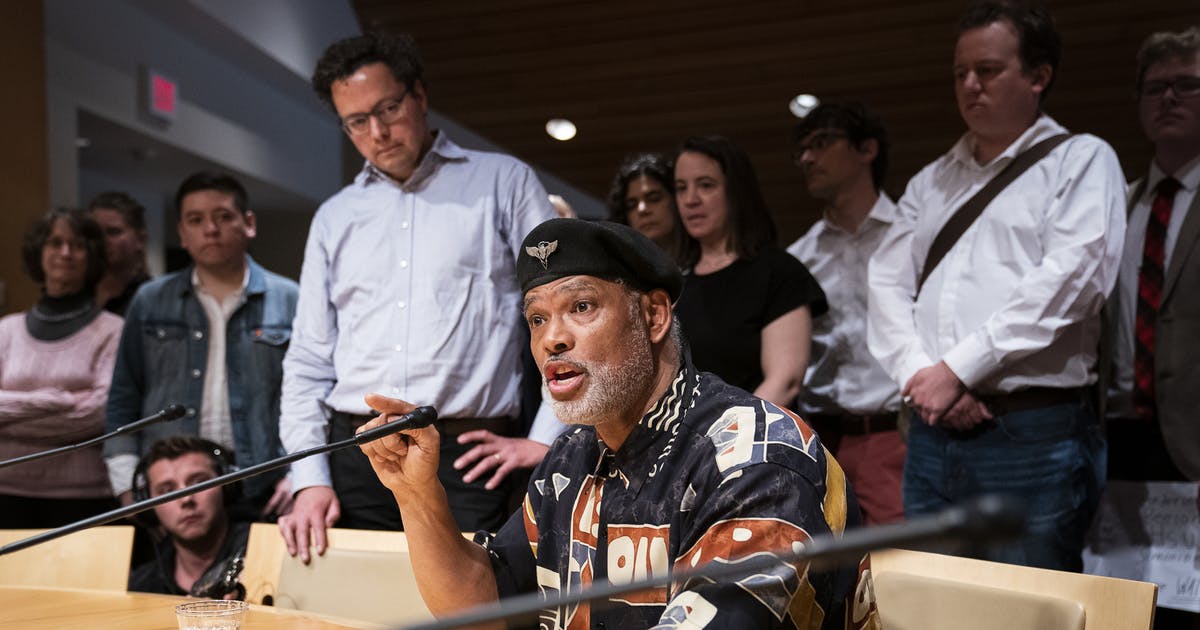
Worker Center intervenes to stop Regents from arresting Professor John Wright, founder of African & African American Studies Department

(Member report)
The UMN Board of Regents were going to arrest and remove Professor John Wright — founder of its African American & African Studies Dept, civil rights activist, MacArthur fellow (nominated by novelist Ralph Ellison) — from their farce of a meeting yesterday about the building re-naming commission’s report, until the Minnesota Higher Education Worker Center acted by surrounding him, and persuaded other members of the audience to join us at the front. We overpowered the Regents, and John spoke for 17 minutes, dismantling the nonsense that the Regents have been spewing the last few weeks, their distortions, lies, and apologies for racists, anti-semites, FBI informants, and segregationists. (Also, if you listen carefully as we’re asking for more people to surround John, about 40 seconds in, Regent Johnson says : “Board members, we will take a 5 minute recess, and WE ASK LAW ENFORCEMENT TO REMOVE THEM” — So much appreciation for the faculty, grads, staff, and students who came forward with me to protect John despite this disgusting plea to the police.) I urge you to listen to some of his powerful speech.

‘Audience members often interjected during the meeting, calling for more respect for faculty and assailing regents’ reading of the historical record. In one dramatic moment, faculty and students gathered around retiring Prof. John Wright, who is black, to prevent campus security from removing him until he could address the board. Regent Dean Johnson, who chaired the meeting and at first said police would eject Wright if he did not resume his seat, relented and allowed Wright to speak.

Wright, whose aunt was a campus activist during former President Lotus Coffman’s tenure, said his policies had a chilling effect on the attendance of black students — a reality that is well-known among the state’s black community.

“This is an issue of honor and institutional integrity, and nobody has a permanent lease on honor,” Wright said, adding that a “conspiracy of silence” around the U’s history is over.”‘

And follow Minnesota Higher Education Worker Center for updates and next steps. We’ve been organizing for over a year now to address the Board of Regents’ incompetence and authoritarian tendencies, as well as the overall right-wing and corporate infiltration of this public institution — and the complicity of most of the rest of the U’s power structure — and we will continue to build power and fight back.

http://www.startribune.com/university-of-minnesota-regents-vote-to-keep-coffman-union-name-other-campus-building-names/509127872/

What Are Graduate Fees and Why Do They Continue to Increase?

Graduate student workers at the University of Minnesota must pay outsize and mandatory fees amounting to 10% or more of their annual stipends, a percentage that has been rapidly increasing in recent years. Britt van Paepeghem (Ph.D. Candidate) and David Valentine (Associate Professor) from the Anthropology department explain why this is a bad deal for graduate student workers, faculty, and the future of the University itself.

There has been long-simmering discontent about the astonishing increase in and size of the mandatory graduate student fees charged by the University of Minnesota in the past decade or so. Research by the both Grads United[1] and the Council of Graduate Students indicates that University of Minnesota fees are among the highest—if not the highest—among our peer institutions, many of which have fees that are orders of magnitude lower than those charged at Minnesota. While we understand that other institutions may have different financial situations and models, the comparison still raises the question: why have the fees at Minnesota gotten so big, so quickly? In this blog post, we are driven to discover some of those reasons, as well as the consequences such a large student fee has—not only for current graduate students, but also for the future of the University itself.

Though there have been earlier efforts to draw attention to the out-of-control fees, in the 2017–2018 academic year Grads United kicked off a university-wide campaign to abolish graduate student fees outright. Grads United sees these fees both as arbitrary and as an undue financial burden on graduate students. More importantly, they argue that this is a graduate student worker issue: graduate students employed as Teaching Assistants (TAs) or Research Assistants (RAs) must pay their fees prior to being put on payroll, essentially making the fee a “tax-to-work.”

That tax has increased dramatically in recent years. While the fee varies across colleges, evidence from the College of Liberal Arts (CLA) makes the point. In CLA, the annual fee for US nationals/residents increased from $782 in Academic Year (AY) 2004/2005 to an astonishing $1,606 in the 2017/2018 AY, an increase well over 100% in just over a decade. Compare this to the $328 annual fee charged at the equivalent college at the University of Michigan for AY 2017/2018. Though TA/RA stipends have also increased (in CLA, from $11,200 in AY04/05 to $17,500 in AY17/18), the fee has increased at a much higher rate, meaning students are taking home proportionally less in take-home pay from an already meager stipend. And yet, graduate students have seen very few obvious improvements in services, facilities, or resources resulting from this fee.

At the same time, the cost of living—and especially housing—is also increasing in the Twin Cities area. As such the fee results in a significant reduction in real wages, a reduction that keeps increasing in proportion as stipends remain stagnant and living costs rise. As Grads United representatives point out, the fee further burdens students who are already in precarious positions such as minority graduate workers, graduate workers from working class backgrounds, and graduate workers with dependents. For many, this means having to find work outside the University, taking time away from their training, research, and teaching. And that doesn’t even take into account the burdens experienced by international students, who are assessed additional fees.

Apart from the size and rapid increase, the manner in which the University administers the fee further indicates how out of touch it is with its own graduate student workforce. Graduate student workers are required to pay the first half of the student fees at the very beginning of the semester in order to avoid penalties and further late fees, a significant outlay which makes paying rent and basic living expenses difficult just as students are trying to establish themselves for the new academic year. First-year students are often startled by this unexpectedly large payout that the University demands. And not paying fees is quickly punished: non-payment results in a student losing “good standing” status, which in turn disqualifies a student not only—as we note above—from working as a TA or RA, but from registering for classes, from applying for certain grants and fellowships, or from serving on committees that would otherwise enhance a graduate student’s experience,

And then there are international students. International graduate students are required to pay upwards of $360 annually on top of other university and college fees. The rationale for this additional fee is that it supports the International Students and Scholars Services (ISSS) office, a crucial institution within the University. However, this rationale raises budgetary, philosophical, and ethical questions.

First, while other central offices such as Student Services or the Libraries are funded through cost pools (to which colleges contribute), ISSS appears to be the only central office that depends on a direct student fee. It is important to note that the international student administrative fee was first instituted in 2000, indicating that a transfer of costs of a core University unit to individual students is relatively recent.

Second, international students are often the least likely to be able to afford what is essentially a tax on their citizenship, even as they face additional expenses that the University does not cover (such as visas, travel home, and the added costs of finding housing from another country). Additionally, international students on F and J visas are prohibited by federal law from working outside the University, cutting off one source of income that some US national students are increasingly having to turn to in order to make ends meet.

Our greatest concern about the international student fee, however, is ethical, and arises from the implied principle in the disparity, i.e. that international students should pay extra for the privilege of studying at Minnesota. Yet, it is precisely the presence of international graduate students that gives the University Minnesota the intellectual capital to claim its status as a major research institution. Likewise, a good deal of University of Minnesota research takes place in non-US locations and depends on the good faith contributions of non-US collaborators, community members, and research subjects, enabling our US faculty, graduate students, and the university itself to claim a global perspective. Given these points, asking international students to pay an additional annual fee for matriculating at Minnesota—some of whom have even been collaborators with our faculty in their home countries—seems cynical at best and unethical at worst.

Faculty are also starting to pay attention to the situation. In April 2017, a group of graduate program Directors from 36 programs in nine colleges across several University of Minnesota campuses wrote a letter to Provost Karen Hanson and Graduate School Dean Scott Lanyon to address their common concern about the size, rate of increase, and disparities in the graduate student fee. Outlining many of the same concerns that Grads United have emphasized, the 36 co-signers additionally noted that the fees have serious consequences for graduate programs themselves. It is broadly acknowledged that the University of Minnesota lags behind its peer institutions in terms of TA and RA stipends, and every year faculty return to the problem of the U’s “competitiveness” as we try to attract the strongest students in the face of more lucrative offers from peer institutions.    

The outsized graduate student fee only complicates this work. Many faculty have expressed concern to the letter’s authors that growing discontent about the graduate student fee will have ramifying consequences in upcoming admissions cycles, only amplifying the overall trends in graduate student applications—after all, candidates for admission talk to current graduate students, and regardless of current students’ enthusiasm for their program, funding and fees are a key consideration to communicate to candidates. For faculty, then, the graduate student fee issue is neither ancillary to their program concerns nor only a matter of justice: it is having a real and material impact on the strength of our programs and of the national and global profile of the University.

Moreover, it is also the case that some programs have not always adequately informed admitted candidates of the fee, or provided details about when it must be paid and the consequences for late payment. Chief among the complaints that graduate program Directors have heard from incoming first year students is precisely how shocked they were, both by the size of the fee they owed, but also the early payment deadlines, not to mention the punitive approach taken by the administration for late payment. Part of this may simply be the disconnect in faculty understanding of graduate student worker conditions (which is hardly a new situation). But even understanding the situation may not be enough. Graduate program Directors are responsible for communicating information about the fee to candidates, but they are simultaneously tasked with recruiting exceptional graduate students upon whose success their programs—and the University at large—depend. As such, the crucial information about the fee may get sidelined or underemphasized, to the detriment of students who do not realize the financial obligation for which they are signing up.

The response to the Directors’ letter came from Dean Lanyon. His reply was concerned and thoughtful, but implicit in his response was the sense—as it is so often when a budgetary model is in question—that the status quo itself is unchangeable. (We include Dean Lanyon’s breakdown of the fee for AY 2016/2017 below [2]). Dean Lanyon noted that all fee increases are discussed by the Executive Vice President and Provost, Vice President for Research, Vice President of the Academic Health Center, and the Vice President and Associate Vice President of University Finance. These officers make recommendations to the President who reviews them and then forwards his own recommendation to the Board of Regents. It is the Regents who make the final decision about whether new fees should be approved or existing fees increased. In short, the rapid increases in fees over the past decade have been routinely voted into place, shifting administrative costs to those at the University who are least able to afford them, with little regard to the consequences for graduate student workers, and without transparency as to the reasons for such dramatic increases. All this while graduate student stipends have remained flat for long periods of time, or even decreased in value in relation to the actual cost of living. The implication is that graduate students are understood by the administration primarily as budgetary costs rather than as fundamental and essential contributors to the University’s core mission.

Dean Lanyon also noted one of the thorniest issues that revisiting the student fee raises: a large proportion of the fee is assessed by colleges, and it can vary—as he wrote—“dramatically.” In 2017, the fee for students in the College of Food, Agricultural and Natural Resource Sciences was $165 per semester; that for students in the Carlson School of Management was $870 per semester. The University’s financial model—which has negative consequences across the board—thus balkanizes the fee and makes it hard to address the overall burden carried by graduate students, while encouraging colleges to employ the same equation: graduate student = cost. While we recognize that some colleges—for example, the College of Pharmacy—charge students for materials that they directly use in their training, other (perhaps most) collegiate fees do not obviously or transparently benefit students directly. However, and once again, the dramatic and ongoing increase in fees across the board raises questions about how administrators understand and value graduate student workers when they consider the question of fees.

It is important to note that we are not calling for a defunding of the activities, offices, programs, resources, and organizations that fees are currently paying for, and we recognize that graduate students benefit from these various entities (if some more than others). Rather, we argue (1) that funding for these entities ought not be automatically linked to student fees; (2) that we need to reexamine the fee in relation to the complex financial structure of the university; and (3) that the University must revise its understanding of graduate student workers as budgetary liabilities and come to see them (again) as a fundamental constituency in meeting the University’s research, teaching, and service missions. Regardless of the fee review process, the rapid increase of the fee over a short period of time indicates that the University has not considered the real costs: the corrosive consequences of the fee to its own present and future success. It’s time to do something about this problem, and soon. We call on the administration to lift this undue, unchecked, and unfair burden and, instead, prioritize the needs of graduate student workers—US citizens and international students alike—whose labor is at the heart of the research, educational, and service missions of the University.

______

1. Grads United is an all-volunteer group of graduate teaching assistants, research assistants, and PhD fellows from across the University that advocates for the needs and interests of graduate workers, and aims to organize and build power for a more equitable University.

2. Breakdown of the graduate student fee (for AY 2016/2017), as reported by Prof. Scott Lanyon, Dean of the Graduate School (as such, these are slightly lower than the AY 2017/2018 figures we cite above).

REQUIRED UNIVERSITY FEES

STUDENT SERVICES FEE
All students registered for six or more credits are charged $432.18 per semester. This fee includes $24.33 for student groups, $129.93 for Boynton, $114.83 for Recreation & Wellness, $125.87 for Student Unions, and $33.22 for assorted other programs (Aurora, Learning Abroad, MN Daily, Radio K, Student Legal Services). In addition, Graduate Students who are registered for at least one credit are charged $10.56 to support the Council of Graduate Students.

CAPITAL ENHANCEMENT FEE
All students paying the Student Services Fee are also charged $75 per semester to support student life facilities (e.g., Rec Center, Student Unions, etc…).

STADIUM FEE
All students paying the Student Services Fee are also charged $6 per semester as part of the debt service on TCF Bank Stadium.

TRANSPORTATION FEE
All students paying the Student Services Fee are also charged $24 per semester to subsidize the cost of campus public transportation.

INTERNATIONAL STUDENT ADMINISTRATIVE FEE
All international students are charged $145 per semester to support federally mandated reporting functions and other services provided to international students by International Student & Scholar Services (ISSS).

COLLEGIATE FEES
In addition, to the university level fees, colleges charge a collegiate fee. Typically, there are two levels of these fees depending on the number of credit hours for which a student registers. These fees vary dramatically in the amount and their purpose.

Who We Are and This Newsletter

Since the formal end of the faculty unionization drive early this year, some of us decided we would continue to fight for changes we had sought through unionization. We organized ourselves into a collective called the Minnesota Higher Education Worker Center. Others have joined us, attracted to this independent, open-ended formation. We are not many, but we have been busy. In February, we found ourselves standing alongside some of the bravest and, not surprisingly, most criminalized, students at the university, openly confronting the President and Regents of the University over their attempt to subvert the democratic processes of our institution and its norms of free speech. We took on the issue of contingent faculty access to email and the library. We are now in the midst of working on fundamental issues that highlight the differences between how the University of Minnesota’s power-holders like to portray the U and what the U actually is — the image we see on admissions brochures of shiny new buildings and diverse, smiling students versus the truth of a largely unaccountable, inaccessible, and unaffordable corporation-in-disguise.

One aspect of the student code of conduct issue draws out this tension between image and reality: Regent Darrin Rosha has been active in the attempt to change the Student Code of Conduct to address sexual misconduct, which somehow turned into an attempt to criminalize student protest (see  “Criminalization of Student Activism and “How the University Works”). It turns out that Regent Rosha was under investigation for allegations of sexual misconduct at the McNally Smith College of Music, an investigation that cost the University of Minnesota $34,000. How is it that someone who was under investigation for sexual misconduct at one university should be deeply involved in attempts to address that very issue at another university? Where were the President and other Regents, some of whom were required to know about this investigation? This incompetence and lack of probity of the Board of Regents and President boggle the mind and reveal the fundamental problem in the way power works at the U. We have somehow come to accept this model, which presents the university as an institution run benevolently and paternalistically by its Board and President. Isn’t there enough evidence now to call this undemocratic and top-down model into question?

Making our institution truly democratic, transparent, and accountable — not an autocracy utilizing democratic organs to legitimize its moves — is fundamentally necessary to the future of higher education.  This is one of the core principles of our group. We will be going into much more depth about this in future newsletters.

We see these newsletters as both a record of our activities, and a developing vision of why we are working outside of the institutional structures of the university. Most of us have been very active in university governance. Some of us worked towards unionization precisely because we witnessed firsthand how weak governance actually has been — and how the U’s power-holders use governance merely to give the impression that they have engaged in consultation and democracy. While not discounting the important and often thankless work that we and our colleagues are doing in governance, which sometimes of course does have meaningful victories, we must acknowledge the current state of both our university and higher education more generally. Faculty governance did not save the University of Wisconsin. In fact, it was a distraction for so many until it was too late and they finally realized that a faculty union with legal powers would have been much more effective at protecting the university. University governance, including largely defanged student governance, has had little to no effect on the spiraling tuition and debt of our students. It has done nothing to stop our institutions from being turned into real estate development corporations. It has had barely any effect in non-unionized institutions on the increasing number of contingent faculty and precariousness of their positions.

We believe that the only way to reverse these trends is through an independent organization that is structured so as not to be co-opted and used as a rubber stamp by university power-holders. Even from the experience of only a few months, we are coming to see that such an organization must include and work closely with students, staff, and other workers. It also should be in more meaningful relationship with our surrounding community, who have direct experience of the U becoming inaccessible, unaffordable, and in many ways harmful to them.

If you would like to get involved, whether you are a student, faculty, staff, or community member, please contact us at mnhigheredworkercenter@gmail.com.


The Criminalization of Student Activism

On Friday May 13, 2016, several students at the University of Minnesota attended a Board of Regents meeting to express our concerns about the skyrocketing costs of tuition. To make our case, a number of us added our names to a list of those who would be granted a 3-minute opportunity to address the Board of Regents directly. With a tuition bill, diploma, and death certificate in hand, I approached the podium and began my remarks by stating “Life or debt is just a few letters short of life or death.” This was not an attempt to be hyperbolic. Poor and working-class students experience a liminal existence at the University because of the compounding expenses of tuition, housing, food, and other living costs. The price of life for poor and working-class students exceeds what they actually earn to make a living. The Board of Regents justifies its repeated decision to raise tuition under the guise of remaining competitive with other Big Ten schools. Last time I checked, the University of Minnesota was supposed to be a leader among state schools. What does it mean then when internally this “leader” is more interested in following the trends of capital and capitalism to keep pace with its counterparts? For poor and working-class students, especially poor and working-class students of color, it means we are moving towards extinction at the University.

Extinction seems like a logical outcome given that many of us are learning in a space that was designed without us in mind. To be more specific, we are learning, laboring, and to a large extent living in a land grab institution that is more anti-ebony than ivory, more private than public, and presents students with more educational opportunists than educational opportunities. For those marginalized along the lines of race, gender, class, sexuality, ability, and citizenship granted admission into the academy, we are told they are part of a “privileged” group. Lest we forget about our “privilege,” we are awarded scholarships, fellowships, President’s Student Leadership Awards, and Outstanding Community Service awards to remind us of the academy’s benevolence. I reject the notion that I am privileged to be in this position for several reasons. It’s not a privilege to have students and professors alike question your integrity, intelligence, and personhood in spaces that are supposed to be most conducive to learning. It’s not a privilege to be so disconnected from your community that you feel guilt ridden when hardships hit home. It’s not a privilege to be racially profiled, searched, and criminalized by the University of Minnesota police, who construct you as guilty before proven less guilty. It’s not a privilege to be maced for trying to prevent white supremacists from coming to campus. It’s not a privilege to be maced by police during an evening of celebration for Somali people. By definition, if it is a “privilege” to be somewhere, this suggests that certain groups aren’t supposed to be there.

On June 10, 2016, we were reminded of the lack of privilege we actually hold as the underrepresented at Predominantly White Institutions (pronounced pee-wee). This was the day the Board of Regents decided to vote on proposed tuition hikes. Over 50 students from various student cultural centers and other student groups packed the Board of Regents to ensure that the vote was not passed without resistance. Some administrators exclaimed how amazing it was to see so many engaged students, especially given that the vote was occurring in the beginning of the summer recess when most students had already left campus for break. Little did these administrators know that we were not simply there because we were “politically engaged students.” We were politically enraged students. Enraged by the fact that the University was intent on passing tuition hikes without any regard for the harm it is causing multiply-marginalized students. Before the Regents meeting, President Kaler announced that in light of concerns expressed by members of the University community, he and the Board of Regents decided to reduce the amount of the tuition hike to 7.5% instead of the original 9.9% increase for nonresident, non-reciprocity undergraduates. In-state or reciprocity undergraduates would also see a 2.5% increase. I guess this is what the University considers “progress” that can be attributed to advocacy. Malcolm X said that “If you stick a knife in my back 9 inches and pull it out 6 inches, there’s no progress. If you pull it all the way out that’s not progress. The progress is healing the wound that the blow made. And they haven’t begun to pull the knife out, much less heal the wound. They won’t even admit the knife is there.” As members of an aggrieved group at the University of Minnesota, we cannot allow the University to set the terms and conditions for our existence. We are not interested in continuing to acclimate ourselves to adversity. Hegemony requires consent. Consent that we refuse to give. We made this clear at the beginning of the Board of Regents when we started our chants. “Hey Hey! Ho Ho! Tuition hikes have got to go!” was heralded and we took over the meeting. We proceeded to read our mission statement and presented the following four demands:

  1. Treat college education as a public good
  2. Immediate free tuition for American Indian students
  3. President Kaler’s immediate resignation
  4. Divestment from Black Rock Investment portfolio

The Board of Regents did not engage with any of us or our demands. Instead, they recessed into a private room during the disruption and fed us to the belly of the beast. We were warned by police that we were violating a law and if we did not leave the space, we would be arrested. Six students remained holding a banner that read “Nothing about us, without us, is for us.” Realizing that we would remain until their demands were met, the police proceeded to arrest us. We were originally issued a charge of “unlawful assembly.” However, the City Attorney added “trespassing” (on already stolen land) and “disorderly conduct,” to the list.

We created a legal defense fund to retain the support from attorney Jordan Kushner. The City Attorney asked us to plead guilty to one misdemeanor with a stay of imposition and vacate and dismiss after one year, conditioned on two days of sentence to service (STS), and a $178 fine. We refused and instead demanded the case be brought to trial.

On December 13, 2016, over six months after the initial Board of Regents action and one day before the first day of trial, the City Attorney dismissed the charges against us. For over six months we were forced to live in agony and anxiety over their fates within the criminal-legal system. In addition to building a political campaign to end the criminalization of dissent/defense on campus, many of us were laboring as undergraduate and graduate students, teaching assistants, instructors, and full-time employees outside of the university. Had we not organized a campaign that included support from students, faculty, student groups, and members of SEIU Local 284, the outcome would have likely been different.

However, the ordeal was not over. We were subject a form of “double jeopardy” by being punished by both the state and the Office of Community Standards and Academic Integrity at the University of Minnesota. Many of us were subjected to participate in a pseudo “restorative justice” process, where we were shamed, humiliated and offended by a tag-team effort by University officials and contracted organizations intent on expanding the nonprofit industrial complex. We were asked to participate in a restorative justice process for attempting to restore justice to an aggrieved community at the University of Minnesota – students multiply-marginalized along the lines of race, gender, class, sexuality, ability, and citizenship. Essentially, we, the harmed and aggrieved group, were subjected to further harm by the harm-doer.

Student activists, particularly student activists, at the University of Minnesota know that when they are racially profiled and targeted by UMPD, there is little reason for us to abide by the law because the law does not abide by us. For those of us committed to anti-oppressive work and effecting positive change on campus, we must accept the sobering reality that we are more likely to see arrest records before we see diplomas. We just have to decide which one we consider to be a greater badge of honor. Do we grant legitimacy to a piece of paper from an institution that regards us as “illegitimate” or do we take pride in the record we receive from the Office of Community Standards and the criminal-legal system? If neither option makes us feel all that good, then we have to continue to upset the setup!